



-
On the Gender Continuum
By the age of five, I began to realize that I did not fit into the socially constructed Gender Binary. “Gender norms” were always complicated for me. The Gender Binary and its strict gender norms felt beyond constraining and foreign to me.As I became more aware of how uncomfortable I was, I began to act out against these constraints finding myself in the Principals office at the age of eleven for refusing to make a skirt in Home Economics.
When the principal asked why I would not make a skirt, I replied that I had no use for a skirt and I wanted to go to the Industrial shop. I was told that I was a girl and only boys could go to the Industrial Shop.
My choice was to make a skirt or sit in the principals office. I chose to sit.
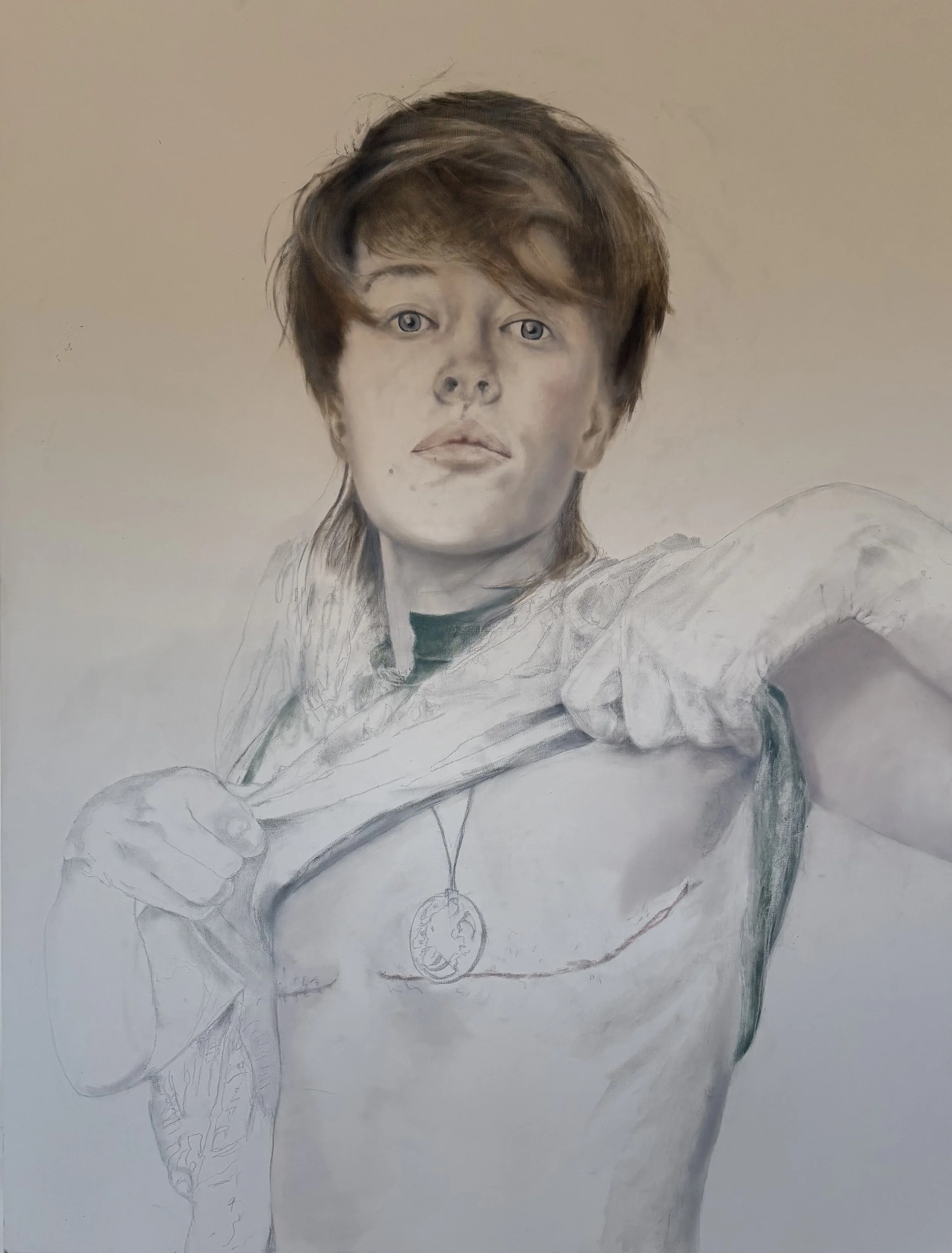
This Portrait project is a deeply personal journey for me.
-
“I love how gender exists so differently for kids, in that at certain points it doesn’t seem to exist at all. I’ve spent a lot of time working backwards to find that place of carelessness, of feeling unobserved.
I have so many photos that my family loved, and looking at them I can remember just how uncomfortable and overwhelmed I felt in that moment, and how unfamiliar the person in the photo was.
Costume played into things a lot, a huge portion of my photos being myself and my friends decked out in layers of clothes scrounged from our parents, making up stories where we played characters of any gender.”
-Elliot -
From a young age, I always knew I was different. The expectations and social norms tied to the gender I was assigned at birth never sat right with me. They felt foreign, restrictive, and deeply dissonant. It was more than discomfort, it was a quiet agony that made me feel alien in my own body. Even hearing or saying my birth name made my skin crawl. I avoided it completely, even when meeting someone who shared the same name. It felt like speaking poison.
Without acceptance from my family or friends, I internalized a heavy sense of shame. I turned inward and, in doing so, adopted beliefs that were harmful and narrow-minded. I didn’t yet understand the war that was happening inside me. I only knew that I felt wrong, angry, and broken. For years, I existed in silence, unaware that what I needed wasn’t to be fixed but to be seen.
Everything began to shift in adulthood. A good friend—gentle, patient, and supportive—helped me begin to understand myself. Through them, I finally came to terms with who I am. I realized that I am gender fluid, and I feel most aligned using they/them pronouns. That realization felt like finally exhaling after years of holding my breath. I finally had a sense of identity. The same friend also helped me find my name: Fox. From that moment on, I never struggled to say my dead name again. I had shed it. For the first time in my life, I felt like I had come home to myself. I began to feel proud of my body, proud of my presence, and proud of simply existing.
Choosing my name was a deeply intentional and spiritual act. During my exploration, I learned that not all cultures follow a binary concept of gender. In some Indigenous North American traditions, for example, there are identities known as Two-Spirit. These may reflect a blend of masculine and feminine energy, but not always. Sometimes they express double masculinity, double femininity, or something that exists entirely outside of those frameworks. That broader understanding of gender resonated deeply with me. I also drew inspiration from the tradition of using animal names, which felt grounding, connected to nature, and beautifully neutral. After my friend passed away from cancer, I chose their favorite animal as my name. It was a way of honoring them, keeping them alive within me, and stepping fully into my truth.
Naming myself gave me life. It gave me freedom. It gave me me.
I believe representation matters and not just for visibility, but for survival. So many people still don’t understand the gender spectrum and especially those outside the binary. I used to be one of them. I’m not proud of that, but I believe ignorance, when met with even a sliver of openness, should be responded to with compassion rather than cruelty. Sometimes, a little understanding and patience can save someone’s life. It did for me.
-
California-born singer/songwriter and multi-instrumentalist Joe Stevens is a third-generation professional musician in a long line of restless westward moving souls. He caught the songwriting bug at 15 and has been at it ever since. After starting out as a self-taught guitar player and songwriter, he received a Bachelor of Music from Cornish College of the Arts in Seattle, WA, and has been traveling with his music across the US and abroad. Between 2006 and 2012 Joe’s first band Coyote Grace released five well-loved albums and toured with the Indigo Girls, Melissa Ferrick, and Girlyman; sharing stages with Chris Pureka, Greensky Bluegrass, Reverend Payton’s Big Damn Band, and legends such as Cris Williamson and Lowen and Navarro.
-
Juli Vizza is an Emmy Award winning editor and producer with two decades of experience in both fiction and non-fiction filmmaking. Their films have premiered at Sundance, Berlin, and Tribeca and have aired on PBS, Showtime, and The History Channel, among others.
They recently edited LET THE CANARY SING a biopic on the legend and icon, Cyndi Lauper, which premiered at the 2023 Tribeca Festival. Their previous series, AND SHE COULD BE NEXT, premiered at the 2020 Tribeca Film Festival and aired on POV.
Other recent credits include DREAMS OF DARAA, a feature documentary about a Syrian woman seeking justice for her murdered husband and safety for her three daughters; WORLDS OF URSULA K. LE GUIN a film about the groundbreaking science fiction and fantasy author which won five festival awards and was broadcast on American Masters. Juli also co-produced and edited XMAS WITHOUT CHINA (SXSW, PBS) and produced NINE TO NINETY (HotDocs, PBS, IDA Award Nominee).
Juli was a recipient of the 2021 Sundance Adobe Mentorship Award, and has been a Sundance Producing Fellow, a Film Independent Producers Lab Fellow, and a Fledgling Fund Fellow. They are a member of the Alliance of Documentary Editors.
-
Keller’s work has appeared in The New York Times,The Nation, The Brooklyn Rail, Out, Out Traveler,The Provincetown Independent, Provincetown Arts, Parterre Box, and Early Music America.
Raised on Cape Cod, Keller holds a B.A. in music and art history from Harvard, and an M.M. in musicology from the University of Edinburgh. In the fall, they will be starting a Ph.D. in musicology at the CUNY Graduate Center.
Currently Brooklyn-based, Keller writes the substack Poison Put to Sound, and is working on a book about the cello and the trans body. Their proudest achievement, however, is getting a driver’s license at the age of 24.
For more information: (Saskia) Max(well) Keller
-
My Soul Has No Gender
Seventy countries. Seventy kitchens, seventy languages, seventy rewrites of human history. When you live your life out of a suitcase for that long, your passport stops being a collection of stamps and becomes a ledger of unlearning. You quickly find that the further you travel, the more the world strips away the neat, rigid boxes we build to keep ourselves safe.
We love boxes. We box up god into competitive religions, and we box up humanity into strict, gendered expectations of what it means to be a man or a woman. But the earth doesn't care about our binaries. The ancient stones, the sweeping mountain winds, and the sacred sanctuaries built by our ancestors don't demand a performance of masculinity or femininity. They don’t check your ID or ask which holy book you swear by. They operate on a completely different frequency.
I didn’t learn this by reading theory; I learned it through the soles of my feet and the palms of my hands.
I have experienced certain unexplainable links to something or things that were connected to the places that I travel to that bringing me an elevated experience. I called these higher vibrations and I felt it when I put my hands through one of the stations in the temple in Borobudur, Jogjakarta in Indonesia. I felt the same intense connectivity when I visited a coptic church in Cairo, Egypt. As I did when I meditated in Machu Picchu. Or when I placed my hand on The Wailing Wall in Jerusalem. These happenstances have affirmed my spirituality isn’t generally fixated on a particular religion and it is therefore beyond the binary which defines me as Nell Ysabel Smith.
Think about the sheer distance between those coordinates. A Buddhist stupa in the humid air of Java. A dim, incense-heavy Christian church in North Africa. A windswept Incan citadel high in the Andes. A limestone wall heavy with centuries of tears in Jerusalem. Geographically and theologically, they are worlds apart. Yet, the energetic pulse humming beneath them was identical.
When my hand slipped through the stone lattice at Borobudur, the vibration didn't speak of male or female deities; it just spoke of presence. In the Coptic church in Cairo, the sacredness wasn't bound by patriarchal rules, but by a raw, timeless human ache for connection. Standing at the Wailing Wall, the collective grief and hope of millions didn't care about pink or blue, man or woman. It was a frequency that bypassed the brain and went straight to the gut.
Experiencing the world this way reveals a liberating truth: the soul has no gender. When you break bread with seventy different communities, you realize that the divine spark inside us is completely fluid. Religion and gender roles are sister illusions. They are artificial fences we build around things that are meant to be limitless.
By refusing to fixate on a single religion, I found a spirituality that refuses to cage who I am. Sacredness isn't a doctrine you memorize; it is a current you plug into. My seventy journeys didn't teach me how to fit into the world—they taught me how to expand. True spirituality is the ultimate freedom. It is the quiet, unbreakable certainty that at our core, we are beautiful, unclassifiable expressions of the universe, living authentically and magnificently beyond the binary.
-
“I have been rolling my eyes at the dominant cultural landscape my entire life. I have felt excluded, dismissed, and confused. No more! Today I am proudly Latinx and queer. I don’t owe anyone an explanation of my culture, orientation, or gender, but I do so anyway because today I am prideful. My mere existence is a fuck you to anyone feeling uncomfortable over me or my Latinx and/or LGBTQIA+ community. I identify as he/him, which includes gender fluidity, basically, I fuck with gender, and have been doing so my whole life. “
Mont received his MFA from CGU ‘11. his artworks celebrate the underdog. Mont’s absurdist environments allow for challenging stereotypes and creating counter-histories. Mont is currently a professor at MVC, MSJC, and SBVC.